What Are CC&Rs? A Plain-English Guide
CC&Rs are the single most authoritative document in any homeowners association. They outrank the bylaws. They outrank the rules and regulations. They were recorded with your county before anyone moved in — and they'll still be binding long after the current board turns over.
Yet most homeowners have never read them. Here's what you need to know.
What CC&Rs actually are
CC&R stands for Covenants, Conditions, and Restrictions. Each word has a specific legal meaning:
- Covenants are promises that bind every property owner in the community. If the CC&Rs say you'll maintain your front yard, that's a covenant — an obligation you accepted when you bought the home.
- Conditions define the terms under which property rights exist. Violating a condition can, in theory, trigger more severe consequences than breaking a covenant, though in modern HOA practice the distinction rarely matters day-to-day.
- Restrictions are limits on what you can do with your property. No commercial vehicles in driveways. No fences taller than six feet. No short-term rentals. These are restrictions.
Together, they form a legally binding contract between every homeowner and the community. You don't sign it — you inherit it by purchasing the property.
Where CC&Rs come from
The original developer creates the CC&Rs when the community is built. Before the first lot is sold, the developer records the document with the county recorder's office. This is a critical step: recording makes the CC&Rs part of the property's legal record, which means they run with the land.
Running with the land means they don't expire when the house changes hands. Every subsequent buyer is bound by them automatically. You didn't negotiate them. You didn't agree to them in the traditional sense. But the moment you closed on your home, they became enforceable against you — and in your favor.
This is also why CC&Rs feel like they were written by lawyers for lawyers. They were drafted during development, often using boilerplate legal language, and designed to cover decades of community life.
What CC&Rs typically cover
The specifics vary by community, but most CC&Rs address:
- Architectural standards — exterior paint colors, fencing materials, roof types, additions, and modifications. Most CC&Rs require Architectural Review Committee (ARC) approval before any exterior changes.
- Property use — whether homes can be used for business purposes, restrictions on signage, rules about satellite dishes and antennas.
- Maintenance obligations — who maintains what. Usually the homeowner maintains their lot and the association maintains common areas, but the CC&Rs define the boundary.
- Pet restrictions — breed limits, number of animals, leash requirements within common areas.
- Rental restrictions — whether leasing is allowed, minimum lease terms (often 12 months to discourage short-term rentals), and caps on the percentage of homes that can be rented at once.
- Parking — restrictions on street parking, RV storage, commercial vehicles, and garage use requirements.
- Assessments — the board's authority to levy regular and special assessments, the process for increasing them, and the consequences of non-payment.
- Common areas — pools, clubhouses, parks, trails. What the association owns, who can use them, and how they're maintained.
If you're wondering whether something is allowed in your community, the CC&Rs are almost always the first place to check.
How CC&Rs are enforced
The board of directors has the authority — and typically the obligation — to enforce the CC&Rs. Enforcement usually follows a progression:
- Notice of violation — a written letter describing the violation and citing the specific CC&R section.
- Hearing opportunity — most state laws and CC&Rs require giving the homeowner a chance to respond before any penalty.
- Fines — if the violation continues, the board can impose fines. The fine schedule is usually defined in the rules and regulations, but the authority to fine comes from the CC&Rs.
- Liens — unpaid fines and assessments can become a lien on the property. In some states, HOAs can even foreclose on that lien.
The board doesn't make up enforcement powers. They exercise powers that the CC&Rs grant. This is a distinction that matters: a board can only do what the governing documents allow.
How CC&Rs are amended
Changing the CC&Rs is intentionally difficult. Most require a supermajority vote of the homeowners — typically 67% or 75% of all owners, not just those who show up to the meeting. Some CC&Rs set the threshold even higher for certain provisions.
The board cannot amend the CC&Rs on its own. This is one of the most important differences between CC&Rs and rules and regulations — the board can update rules with a simple board vote, but the CC&Rs require broad homeowner consensus.
The amendment process typically involves drafting the proposed change, mailing it to all homeowners, holding a vote (often by ballot over a set period), and then recording the amendment with the county, just like the original document.
Why CC&Rs sit at the top of the hierarchy
HOA communities are governed by a document hierarchy:
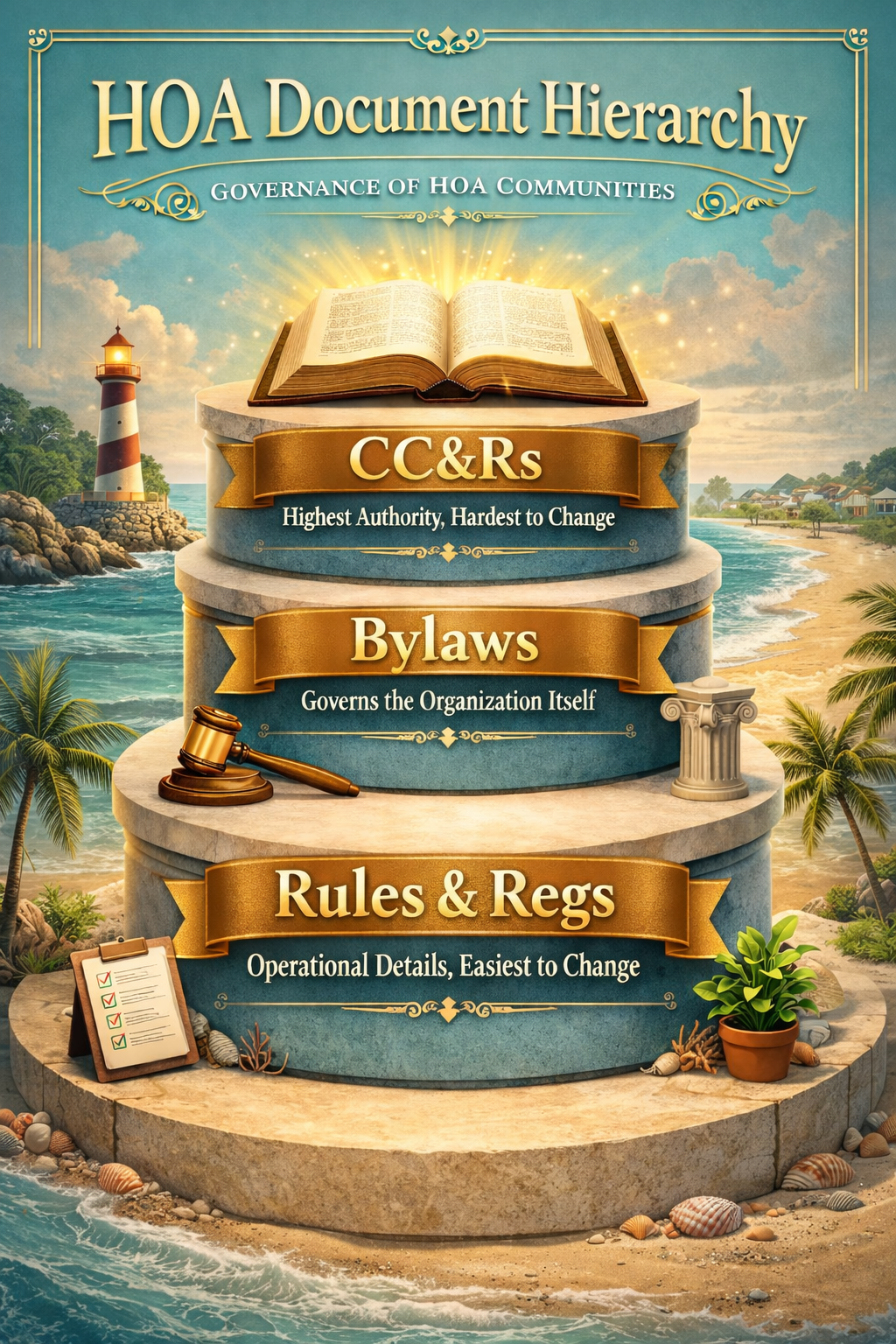
If any lower document conflicts with the CC&Rs, the CC&Rs win. A board resolution can't override a CC&R provision. A rule can't permit something the CC&Rs prohibit. This hierarchy exists because the CC&Rs carry the strongest legal weight — they're recorded with the county and approved by homeowners, not just the board.
Understanding this hierarchy prevents a common source of conflict in HOA communities. When a homeowner says "the board made this rule and it's unfair," it's worth checking whether the provision actually originates in the CC&Rs. If it does, the board didn't create it — they're required to enforce it. Changing it requires a homeowner vote, not a board decision.
For a deeper look at how bylaws and rules fit into this hierarchy, see our companion post: Bylaws vs Rules & Regulations: What's the Difference?
Common misconceptions
"The board can change the CC&Rs." They can't — not without a supermajority homeowner vote. The board governs under the CC&Rs, not above them.
"I didn't sign anything, so the CC&Rs don't apply to me." They do. CC&Rs run with the land. Purchasing the property is the act that binds you.
"The CC&Rs are outdated, so the board ignores them." Selective enforcement is legally risky for the association. If a provision exists in the CC&Rs, the board generally must enforce it consistently — or amend it through the proper process.
"Our CC&Rs expired." Some CC&Rs have a term (e.g., 30 years) with automatic renewal clauses. In most cases they renew automatically unless a supermajority of homeowners votes to terminate them. Check your specific document.
The bottom line
CC&Rs are the foundation of every HOA community. They define what homeowners can and can't do, what the board can and can't enforce, and how the community operates at the most fundamental level. They're not optional reading — they're the contract every homeowner is bound by.
The problem is that most CC&Rs are 30 to 60 pages of dense legal language, which is exactly why so few homeowners ever read them.
Related reading
- How to Read HOA Documents Without Losing Your Mind: a practical way through the whole document set.
- What Happens When HOA Rules Conflict?: how the CC&Rs win a conflict with lower documents.
Your CC&Rs might be 40 pages of dense legal language — but the answers homeowners need are in there. SayWhat finds them in seconds, with the exact section and page number cited. See how it works.
← Back to Blog