What 'Enforceable' Actually Means in HOA Rules
Boards pass rules all the time. Parking restrictions, noise policies, holiday decoration guidelines, rental caps. Most homeowners assume that if the board voted on it, it's enforceable. Most boards assume the same thing.
They're both wrong more often than you'd expect.
A rule is not enforceable simply because the board passed it. Enforceability is a chain — and if any link in that chain is broken, the rule doesn't hold up. Not in mediation, not in arbitration, and definitely not in court.
The authority chain
HOA governance operates as a hierarchy. Each layer derives its authority from the one above it:
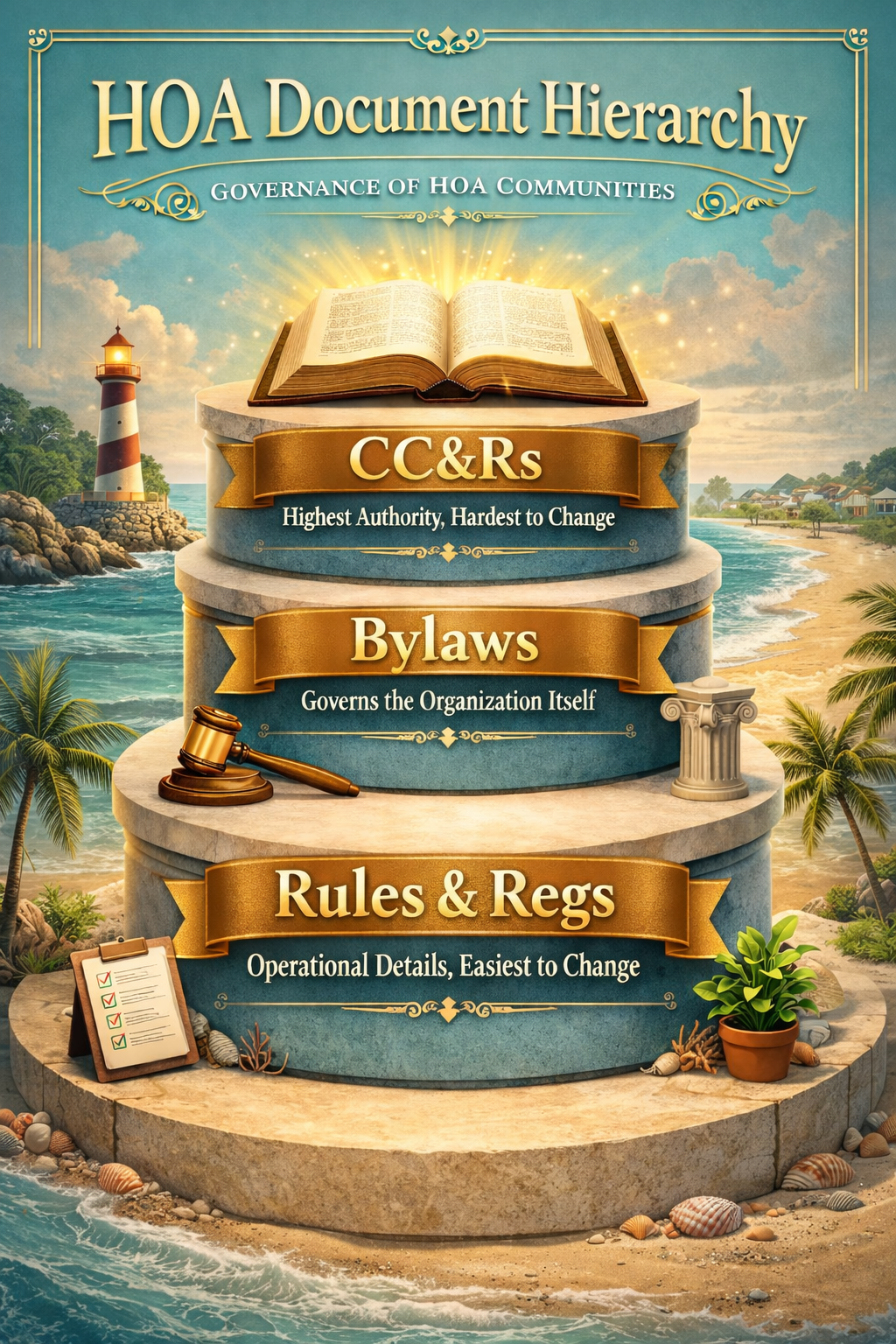
Above all three tiers sits state law, which overrides everything below it.
A rule at any level cannot contradict a document above it. State law beats the CC&Rs. The CC&Rs beat the bylaws. The bylaws beat the rules and regulations. This isn't a suggestion — it's the legal structure that courts use to evaluate every enforcement dispute.
When a board passes a rule, that rule sits at the bottom of the pyramid. It has the least inherent authority. For it to be enforceable, it must derive its authority cleanly from the documents above it.
Four requirements for enforceability
A rule is enforceable when all four of these conditions are met:
1. The CC&Rs grant the board authority to regulate the subject matter.
The CC&Rs are the source of the board's rulemaking power. If the CC&Rs don't authorize the board to regulate rentals, the board cannot pass a rental restriction rule — regardless of how the vote went. The authority has to exist before the rule can.
This is the most common failure point. A board identifies a problem, passes a rule to address it, and never checks whether the CC&Rs actually grant authority over that area. The rule gets enforced for years until someone challenges it and an attorney traces the authority chain back to nothing.
2. The rule doesn't conflict with a higher-tier document.
Even when the CC&Rs grant general authority, the specific rule cannot contradict provisions in the CC&Rs, bylaws, or state law. If the CC&Rs cap fines at $100 per violation, the board can't pass a rule imposing $500 fines. If state law requires 30 days' notice before a hearing, the board can't create a 10-day process.
3. Proper process was followed.
Most CC&Rs and bylaws specify how rules must be adopted: board vote at a noticed meeting, homeowner comment period, written notice to all owners after adoption. Skip any required step and the rule is procedurally defective. Some states impose additional requirements — California's Davis-Stirling Act, for example, requires 28 days' notice and a member comment period before rule changes take effect.
4. Enforcement is applied consistently.
A rule that is enforced against some homeowners and ignored for others is vulnerable to a selective enforcement defense. Courts look at this seriously. If the board fines one homeowner for a fence violation but ignores the same violation from a board member's neighbor, the enforceability of the rule itself comes into question — not just the specific fine.
Common enforceability failures
These are the patterns that get boards into trouble:
Unauthorized rules. The board passes a rule on a subject the CC&Rs never granted authority over. This is especially common with rental restrictions, short-term rental bans, and architectural standards that go beyond what the CC&Rs define.
Selective enforcement. The rule exists and is valid, but the board only enforces it against certain homeowners. This doesn't just jeopardize the individual fine — it can undermine the enforceability of the rule for everyone.
Inadequate notice. The board adopts a rule without following the notice and comment procedures required by the governing documents or state law. A homeowner who was never notified of the rule has a strong defense against enforcement.
Retroactive enforcement. The board passes a rule and then fines homeowners for violations that occurred before the rule existed. Rules apply prospectively unless the governing documents explicitly state otherwise, which they almost never do.
Conflicting provisions. The rule contradicts something in the CC&Rs or bylaws. This sometimes happens when governing documents were amended at different times and nobody reconciled the changes.
The reasonableness standard
Courts evaluate HOA rules under a reasonableness standard. The specifics vary by state, but the general framework is consistent: a rule is presumed valid if it is reasonable, applied uniformly, adopted within the board's granted authority, and not arbitrary or capricious.
"Reasonable" is doing a lot of work in that sentence. A rule prohibiting all outdoor furniture would likely fail the reasonableness test. A rule requiring that outdoor furniture be stored during hurricane season would likely pass. The difference isn't the subject matter — it's whether the restriction has a rational relationship to a legitimate community interest.
The reasonableness standard also means that even a properly authorized rule can be struck down if it's unreasonable in application. A $5,000 fine for a first-time trash can violation is technically authorized by many CC&Rs' general fine provisions, but a court might find it unreasonable relative to the offense.
What homeowners should do
If you're a homeowner facing enforcement of a rule you believe is invalid:
- Request the specific authority. Ask the board to identify the CC&R section that authorizes the rule. Not a general reference — the specific provision.
- Check for conflicts. Read the rule against the CC&Rs and bylaws. Look for contradictions in scope, procedure, or limits.
- Review the adoption process. Was proper notice given? Was a comment period provided if required? Was the vote conducted at a properly noticed meeting?
- Document inconsistency. If you can show the same rule is not being enforced against other homeowners in similar situations, that's a selective enforcement defense.
- Use the dispute resolution process. Most CC&Rs include an internal dispute resolution procedure. Many states require it before litigation. Use it.
What boards should do
Enforcing an unenforceable rule doesn't just mean the fine gets reversed. It exposes the HOA to legal liability — attorney's fees, damages, and sometimes penalties under state HOA statutes. The cost of losing an enforcement challenge almost always exceeds the cost of checking the authority chain before acting.
Before enforcing any rule, boards should be able to answer three questions:
- What CC&R provision authorizes this rule?
- Does the rule conflict with anything in the CC&Rs, bylaws, or state law?
- Are we enforcing this consistently across all homeowners?
If the answer to any of those questions is uncertain, the board should consult counsel before proceeding. The governing documents are the board's authority — and also the board's constraint. Both matter equally.
Related reading
- How to Read HOA Documents Without Losing Your Mind: a practical way through the whole document set.
- HOA Violation Enforcement: What Boards Can and Can't Do: what boards can and cannot do once a rule is broken.
- What Happens When HOA Rules Conflict?: when the problem is two rules, not one.
When a homeowner challenges a rule, the board needs to trace enforcement authority back to the source document. SayWhat makes that chain visible — every answer includes the document, section, and page number. See how it works.
← Back to Blog